When this post goes up, we will be happily gaming away at Gamicon. If you read this before the 28th, come join us at the Sheraton Hotel in Iowa City!

This year we received a ton of games for our Play-To-Win effort. I would really love to play all of them, but don’t have enough time. We did, however, get to play Gobblestones. Check it out…
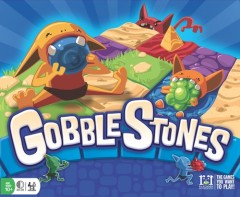
GobblestonesGobblestones
R&R Games, 2015

Gobblestones is a simple, abstract tile placing game. You are playing a hungry goblin who is trying to eat up the most gemstones.

The board consists of 9 square double sided tiles. There are 25 small colored, numbered squares on each side of each tile. The board is made by placing the tiles in a 3×3 grid which will make a total playing surface of 225 colored, numbered squares.

The playing pieces consist of 100 colored surface tiles that are placed into a bag and drawn randomly. The object is to play a straight line of tiles and score the values of the squares on which the tiles were played. You can’t make a 2×2 block of tiles, and can’t turn corners, but otherwise can play as many or few tiles as you want as long as they are all on the same straight line. The more tiles you play, the fewer you draw, so you need to balance your play so you can always make some type of play.

Gobblestones is very easy to learn, but isn’t by any means a “simple” game. Trying to achieve the highest score with your tiles, while managing to keep enough to keep constant play can be a delicate balance. Trying to make a good score without leaving great plays for your opponents can also be quite tricky. Because each tile is two sided, and the game board configuration has lots of different play possibilites, giving the game a good amount of replayability. There are several different possible strategies and an intriguing amount of possibilities for each play.

We did have some difficulties because the tiles have a mirror-like surface, and with our lighting and surroundings, sometimes the colors were difficult to differentiate (gold reflecting a red sweater looks remarkably like the red tiles). There wasn’t any consideration to color blindness either. A simple pattern on each color tile would have easily taken care of this. There are also gray squares which aren’t mentioned in the rules. After playing, we figured out online that the gray squares are wild, but are 0 points.

Overall, this is a quick, light, fun strategy game. I very much enjoyed it and recommend it to fans of games like blokus.
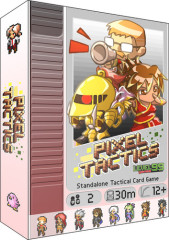
PixelTacticsPixel Tactics,
Level 99 Games, 2012

Pixel Tactics is a two-person duel type card game. You and your opponent are fighting to try to defeat each others leader. The game uses cute 8-bit video game type artwork, and has a unique mechanism that allows each card to have multiple functions. I love this because it gives you so much versitality with only the few cards in your hand. I enjoy this game, and like the humerous treatment of card themes. It is set in the World of Indines, but you don’t need to know anything about that to enjoy this game

The game is played in three “waves” with each player taking two actions per wave. First player switches each round. Each player has a field of play that consists of a 3×3 grid with the Vanguard row at the top, the flank in the middle and the rear at the bottom. Each player starts the game by drawing 5 cards and choosing a leader from those. There leader will not change during the game, and a leader’s death ends the game. I’ll explain more about leaders in a minute when I describe the cards themselves. Once each player has chosen a leader, then the waves start. Beginning with the Vanguard wave, the first player may take two actions. Actions may be recruiting a hero, drawing a card, or in the 2nd round on, fighting your opponent. But here’s the kicker. In the Vanguard wave, you may only recruit or move cards to or from the Vanguard rank in the field of play. Then the flank wave and rear wave likewise. Pixel Tactics Deluxe box comes with a paper playmat which helps the newbie visualize, but isn’t necessary. You can also download a printable playmat.

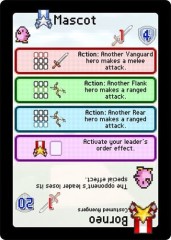
So what I find so cool about this wave mechanic, is that the cards have different powers on them based on which wave you play them in, or if you have used them as your leader. For example, in the card below: If the card were turned upside down, you would be looking at it’s leader power. The leader name is Borneo. It has an attack of 1 and can take 20 points of damage. It’s special power is that it’s opponent’s leader loses it’s special effect. So if your opponent was playing a leader that allowed all it’s ranged attacks to be at +1, for example, that effect couldn’t happen.

But if you don’t use this as your leader, then it remains in your hand, and you can use it then as a hero, in this case, “Mascot”. Mascot has an attack of 1 and can take 4 damage. But it’s special power depends upon where it is in your field of play. On the playmat, the Vanguard rank is red, flank is green and rear is blue. The powers on the card match these colors, and also have a little diagram with the row highlighted, and text saying what the power does. So if you play Mascot into your vanguard, then if you use an action for its power, another vanguard hero can make a melee attack. (Normally a hero would only be able to make one attack). If you used it in your flank wave, then another hero would make a range attack, same if you played it in your rear wave.  I won’t go into more detail here. It’s all pretty self explanitory once you start playing. The rules are well done, and easy to reference as well.

But there is one more thing on the card. Just below the three waves will be another box. In the example it is purple, which means it is an order type card. You can play a card from your hand to use the power in this row. If the color is yellow, then it is a trap that you set for your opponent. If it is gray, then it is an event type card. Sometimes these cards may be played into the field of play (such as a trap). They go in a 4th row below the others, and activate when their conditions are met, if you choose to use them.


PixelTacticsCard


So, as you can see, there are lots of different options you can use with each card. In a starter deck, you might have 25 cards, and each card would be a type that contains a leader. But as you acquire more cards (they are sold in sets, not like CCG’s) you may find other cards that are just heroes with no leader section, or other types of cards. Level 99 Games also offers league and other competitive play options.

Overall I very much enjoy this game and recommend it.