MysteriumMysterium
Asmodee, 2015

Mysterium is a new cooperative mystery themed board game where one player is the “ghost” and the other players are “mediums” attempting to solve a murder by channeling the spirits. This game is simply described as “Clue” meets “Dixit” (see previous review).

At the beginning of the game, a certain number of suspect, room and weapon cards are placed on the table (depending on the number of players). The ghost player sits behind a screen, which shows the assigned suspect, room and weapon for each player. (determined randomly). Each player must try to first determine their suspect from clues given in the form of Dixit-type art cards (see sample below). The “ghost” is not allowed to give clues other than cards. The card may be trying to indicate a color, or an element on the card that is similar to the one on the players target card. The players may discuss, then each player places their crystal ball on the suspect they believe is theirs. If they are correct, then they may move on to do the same thing with their room. If they are incorrect, then the ghost gives them another clue and they try again.

But the players only have 7 rounds to determine their set of clues.  When the suspects rooms and weapons have been determined, then those sets are laid out on the table, and the ghost gives the number of clue cards as has been determined by their time, and the players attempt to guess the final killer. The faster they figure it out their suspect, the more clues they get.

Though this game seems simple, the cards are somewhat abstract, at the intended meaning is often elusive. And the Ghost may not get the best cards available to give the most direct clues.

As with Dixit, the artwork in this game is amazing. It is a lot of fun to discuss and speculate on the clues  you have been given, and amazingly frustrating as the ghost when the players don’t get your hints. The ambiance and theming of the game work very well, and the time countdown gives a sense of urgency and tension.

This is a great game, with lots of replayability, though a group that plays it regularly may start to come up with conventions for which cards mean what things. I have heard players say that they have added their Dixit cards to the mix for giving clues, which would also give the game more variety and possibly difficulty. Highly recommended.

MysteriumCard


(Card picture from BoardGameGeek.com)

DixitDixit
Asmodee, 2008

Dixit is a storytelling card game and won the Spiel de Jahres in 2010. The game is made up of 84 abstract art cards. Expansions are available that also have 85 cards, so there is a lot of variety available.

Each player has a hand of 6 cards. Gameplay starts with the storyteller choosing a card from their hand, placing it face down in front of themselves and giving a short word or phrase that describes the card. This phrase should be somewhat cryptic. Each other player chooses a card from their hand that they feel best matches the storyteller’s phrase and plays it face down. Then all cards are collected, shuffled and placed out faceup. Each player then votes for the card that they feel best matches the description. If no one or everyone selects the storyteller’s card, then the storyteller gets no points, and each other person gets two points. Otherwise the storyteller, and everyone who voted for them gets three points, and each other player who received a vote gets one point per vote on their card. The object is to get to 30 points (various different editions of the game have different point tallying mechanics). You cannot vote for your own card. The story teller doesn’t vote, but uses their vote to indicate their card, so will always “vote” last.

The storyteller must carefully craft their wording to that it isn’t too obvious (or everyone will vote for theirs and they get no points) or to obtuse (in which case no one votes for them).

For example, the picture on the cover could be described by the storyteller as “Adventures in reading” “Imagination” or “And they rode off into the sunset”. Using the word book or waves in the description might pinpoint this card too much. Sunset might also do the same thing, but since it isn’t the focus of the card, could be abstract enough to get by. Using “Imagination” might not be specific enough, but gives the overall “feel” of the word, so would probably get a vote or two. Much of the voting and storytelling will depend on who you are playing with and is a good “get to know you” game.

With a little of “Apples to Apples” and a lot of artistry, this game is fun for all ages. A good imagination is very helpful, and I probably wouldn’t recommend this game to incredibly literal thinkers. Playing with kids is good, but they will probably tend to be very specific about their cards. This game can be great for teaching abstract thought and storytelling.

Very much recommended for creative minded folks.

MadScientistUniversityMad Scientist University
Atlas Games, 2005

Mad Scientist University is a light, simple, storytelling party game. Each player is a student at Mad Scientist University. In turn, each player will get to be the TA. The TA will give each player an Unstable Element Card (Aluminum Cans, Penguin, Lawn Gnomes, etc). Then the TA will give the group an Insane Assignment (Take over the world!). Each player must create a story on how they will use their Unstable Element to achieve the assignment. The TA will choose the best story to win the assignment. After three rounds of play, (Each person will TA once per round) the student with the most won assignment wins the game.

We have had a lot of fun with this game. The Unstable Elements cards have just the right amount of wacky wierdness to make the storytelling easy and fun. The Assignments are general enough to be able to give players a good amount of latitude in their storytelling.  We were playing with the base game and the spring break expansion, and much fun and hilarity ensued. There are several more expansions of the game available, which will give the game more replay value.

If you like storytelling games, then you will very likely enjoy Mad Scientist University. Recommended.

When this post goes up, we will be happily gaming away at Gamicon. If you read this before the 28th, come join us at the Sheraton Hotel in Iowa City!

This year we received a ton of games for our Play-To-Win effort. I would really love to play all of them, but don’t have enough time. We did, however, get to play Gobblestones. Check it out…

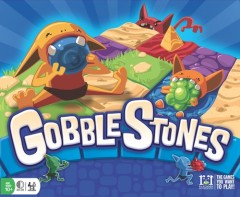
GobblestonesGobblestones
R&R Games, 2015

Gobblestones is a simple, abstract tile placing game. You are playing a hungry goblin who is trying to eat up the most gemstones.

The board consists of 9 square double sided tiles. There are 25 small colored, numbered squares on each side of each tile. The board is made by placing the tiles in a 3×3 grid which will make a total playing surface of 225 colored, numbered squares.

The playing pieces consist of 100 colored surface tiles that are placed into a bag and drawn randomly. The object is to play a straight line of tiles and score the values of the squares on which the tiles were played. You can’t make a 2×2 block of tiles, and can’t turn corners, but otherwise can play as many or few tiles as you want as long as they are all on the same straight line. The more tiles you play, the fewer you draw, so you need to balance your play so you can always make some type of play.

Gobblestones is very easy to learn, but isn’t by any means a “simple” game. Trying to achieve the highest score with your tiles, while managing to keep enough to keep constant play can be a delicate balance. Trying to make a good score without leaving great plays for your opponents can also be quite tricky. Because each tile is two sided, and the game board configuration has lots of different play possibilites, giving the game a good amount of replayability. There are several different possible strategies and an intriguing amount of possibilities for each play.

We did have some difficulties because the tiles have a mirror-like surface, and with our lighting and surroundings, sometimes the colors were difficult to differentiate (gold reflecting a red sweater looks remarkably like the red tiles). There wasn’t any consideration to color blindness either. A simple pattern on each color tile would have easily taken care of this. There are also gray squares which aren’t mentioned in the rules. After playing, we figured out online that the gray squares are wild, but are 0 points.

Overall, this is a quick, light, fun strategy game. I very much enjoyed it and recommend it to fans of games like blokus.