FillTheBarnFill the Barn
Hoopcat Games, 2012

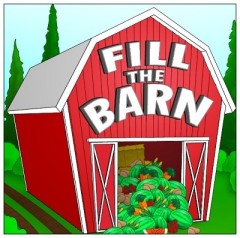
Fill the Barn is a lightweight simple game for ages 8 and up. Each player attempts to plant crops, keep them alive and harvest them to make a profit. At the end of the game, the player with the most money wins.

The game consists of a barn (board) that has 3 spots for 6 types of crops. Each spot has a monetary amount on it, which is the amount the market will pay for harvested crops. A deck of cards holds crops that vary in planting costs, harvest cards with varying costs,  irrigation cars, fertilizer cards, disaster cards,  action cards and junk which can be used to fill up the barn, taking away opportunities to harvest from the players. Each player starts and maintains a hand of 5 cards throughout the game. Each turn, players play one card, then draw a card. Play might be planting a crop, harvesting, tending crops with irrigation or fertilizer cards, or playing actions or disaster cards on other players. Endgame is reached when the cards are gone and no one can play any more from their hands, or when the barn is full, whichever comes first.

Our first play was a two-player game and was a fairly even, play was simple and direct, and the game went quickly. We played again with 5 players which changed the dynamic a little. We did have two “drought” disaster cards come out fairly quickly, which caused one player to lose most of their money, frustrating them for the rest of the game. The simple mechanics and quick play will be attractive to the 8-12 set, but the game doesn’t have a lot of strategic ability for older players. So if you are looking for something for your 7-12 year olds, this would be a good addition to their library, giving them some opportunity to learn simple strategy and basic economic principals. If they spend too much on planting and harvesting, then they won’t receive any profit on their crop. It may also give them a little glimpse on what a farmer goes through to get a crop to market, worrying about such disasters as drought and mice, and learning the value of insurance on a high cost crop.

Nice game with quality pieces and well written easy to learn rules. Recommended for younger players.


CutthroatCavernsCutthroat Caverns
Smirk & Dagger, 2007

Got a few friends who would like to go on a Dungeon Delve, but no one wants to GM? Pick up a copy of Cutthroat Caverns.  Cutthroat Caverns gives you the experience of a good old fashioned dungeon crawl.

The theme of the game is: Without teamwork… you will never survive. Without betrayal… you will never win. You and your friends are a team of adventurers, heading into a dungeon filled with monsters, in order to retrieve an artifact of untold power. Along the way, you will face 9 (or more) encounters. These encounters may be horrible beasts, secret traps, or other nasty foes. These foes will have a number of hit points and an attack. But only the player who strikes the killing blow will get the prestige points that are needed to win the artifact at the end of the game.

You work cooperatively, using a deck of cards which include attacks, tactical maneuvers, actions and items.  Everyone is dealt an initiative card, then secretly selects one of their cards to play that round. Will you play an attack in an attempt to kill the monster? Will you use a tactical maneuver in order to make your next attack more effective? By initiative each player will reveal their card, and see if they have defeated the encounter. If they have not, play proceeds to the next player. At then end of the round, if the encounter has not been defeated, then you re-deal initiative, and the encounter will have it’s attack. You must be alive at the end of the game to win, so keep those healing potions handy! Play proceeds until the encounter is defeated. The player who struck the killing blow receives the card, and the prestige points. After the final encounter, prestige is tallied up, and the player with the most prestige wins the game and receives the artifact of untold power, going on to fame and glory in their career.

The unique mix of cooperative and competitive makes this game fun and interesting to play. If no one attacks, then the creature will continue on its rampage, doing damage to you and others, so it is in your best interest to kill it, but you must play strategically in order to be the one who kills it. The game has some little quirks. Initiative is handed out after the players attack, but before the monster attacks, so you have very little chance to avoid the damage that it deals. This is good because it gives you more reason to want to hurt the creature, because it may be you that it attacks, but bad, because you cannot plan for a way to escape that damage. Very much like it would be in “reality”, if 5 people are attacking a creature, how do you know who will get the attack of the creature? Will you sit out the round, hoping that others will wear it down while you strategize where to make the killing blow?

Every card you play will have an impact, and every person playing will make a difference. It is a board game that really feels like a dungeon crawl.

Highly recommended.

SteamParkSteam Park
Iello, 2013

Like amusement parks? Ever wanted to create your own? Steam Park is a strategic board game in which you must build attractions and support buildings in order to attract visitors and make money. But you must also keep a clean park as well, and visitors litter… In the end, the player with the most money wins.

Steam Park is played over a series of 6 rounds. Each player has a game board and 6 dice. The dice have blank, tent, building, visitor, dirt and dustpan faces.  The first phase is the “roll dice” phase. Players decide on their strategy and all players simultaneously roll their dice, and continue rolling until they achieve the dice combination that they want. However, the first person to achieve their desired roll, will quickly take the first player token, and subsequent players take the following initiatives. Besides getting the early play option, players also receive dustpans or dirt, depending on their initiative placement. So going early is a huge bonus. Players who take a lot of time to assess their rolls will not only play later in the round, but may also have to contend with extra dirt.

After all players have finished rolling and have taken their initiative markers, play moves to the next phase, the “dirt” phase. Some dice faces have dirt icons. Each player counts the dirt icons from their dice, any dirt from their initiative card, and one for each visitor in their park. At the end of the game, players are penalized and must pay to have their dirt removed, so keeping a clean park is very important.

Then, in initiative order, players resolve their dice, building rides of various colors, building buildings which have game effects such as helping with cleaning or giving bonus visitors, trying to attract visitors to their rides, playing cards, expanding their parks, or cleaning up dirt.

Attracting visitors has a strange but interesting mechanic. I mentioned that the rides are of various colors. There are visitors of each ride color. The object is to get the visitors of the same color as your built rides. The game has a bag, which at the start of the game contains one visitor of each of the 6 colors. When you attempt to gain a visitor, you add a visitor of your color choice into the bag, then draw randomly causing the bag to return to 6 visitors, but in differing color combinations,  in an attempt to gain the color visitor you need.  This can cause some nice strategic gameplay as you attempt to fill your park with different color rides, and seed the bag with visitors of the color you need (and deplete it of colors that your opponents need), in order to increase the odds in your favor.

Steam Park is an interesting and fun game with different mechanics, and a good amount of strategic play, and a little luck to shake things up a bit. The components are nice, and the game play is well balanced with many different ways to win. We played a 3 player game, and the all players were within 5 points of the winner.  Some players might be turned off by the “luck of the draw” mechanic for gaining visitors, but we found it added a nice little spice to the game.

Overall, fun and recommended.

FishCookFish Cook
Cheapass Games/2012

In Fish Cook, you and your fellow Fish restauranteers are competing to create an elite menu for your restaurant, fulfilling orders, and making money. Depending on the number of players, the game will be played over the course of 3-5 “days”. Each day consists of a “morning” phase, where players purchase fish, ingredients or recipes for their restaurant, and an evening phase, where players fill orders from their menu, or try to steal recipes from their opponents. At the end of each day, the fish market and farmer’s market are re-stocked for the next day. At the end of the last day, the player with the most money wins.

This game has good strategic play. You must manage your money wisely, to maximize your purchasing power and get the most profit from your recipes. You start with $100 dollars, and must budget to get the best bang for your buck. The hard part is that there isn’t always a good market for the items you need to purchase. As fish and ingredients get scarcer, they get more expensive as well. Recipes that give you the most money, also require the most ingredients. You can win with a strategy of making a few expensive recipes or making a lot of cheaper recipes.

Cheapass Games has a long history of publishing games that supply only the parts required for specific game play, assuming that you could find common parts (play money, dice, etc.) in your own home from other games. They were published with lesser quality components, in order to keep the costs down, and make the games more accessible to everyone. Their first games were published with photocopied black and white cards and multi section photocopied boards, and were published at $5 or under. Fish cook costs $15, still quite a bargain, and comes with 2 — 2 section full color game boards, 36 full color custom “recipe” cards (same stock and finish as regular playing cards), and over 100 full color ingredient tokens, a first player token, and five day markers. The components are decent quality. I’ve seen a lot worse from more expensive games. You will need to 12+ dice and some way to keep track of money. Your Monopoly play money would work, but we keep track with pen and paper and it works just as well.

We found this game to be entertaining, well balanced, and fun.  Recommended.