DuckDuckGoDuck, Duck, Go!
Ape Games, 2008

Who doesn’t love rubber duckies? Who wouldn’t love to play a game that uses real rubber duckies for pawns? Not me. I LOVE ’em. And this game is the perfect combination of toy value, theme and good game play. Each game comes with a variety of rubber duckies, so each game is slightly different, and you can purchase other types of duckies to add variety to your game. The type of ducky has no game effect (other than “bird dogs” see below), so you can use superhero ducks, christmas ducks, or any other theme that you like.

Duck, Duck, Go! is a racing game, much like Robo Rally. In Duck, Duck, Go, you are duckies that are racing around a bathtub (modular board) trying to touch each buoy, and be the first to reach the drain. You move your duckie with movement cards played from your hand, and revealed simultaneously and resolved based on the numbers on the cards. The boards is modular and can be arranged to form many different combinations. Each board piece is made up of seven hexagonal spaces. Some spaces have life rings which act as transporters, and one piece has the drain. The buoys are cardboard pieces which can be placed in any location on the board. The game comes with a few “starter” board combinations, but you can change it up however you want, making this game have a lot of re-playability.

There is a basic game, and an advanced game included in the box. The advanced game adds some special actions, as well as a “bird” dog duckie. As a “catch up” mechanism, the last player “controls” the bird dog, using it to block or set back other players.

This is a good way to get kids to learn higher strategy games. The duckies are fun and the theme is entertaining. It’s a race, so it keeps the action going and keeps everyone in the game. The movement is more complex because it uses hexes instead of squares. Some people with spatial difficulties may have some problems with the movement.

I think this game may be out of print, so if you find a copy, pick it up. And pick up a few extra duckies while you’re at it.

Recommended.
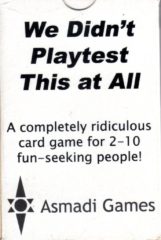
WeDidntPlaytestWe Didn’t Playtest This At All
Asmadi Games, 2007

Everyone is busy. Our lives are so full of things to do, that finding time to play a game can be a challenge.

We Didn’t Playtest this is an easy to learn, simple to play, fast, silly game that can fit in a purse or pocket.

The rules? Start with a hand of two cards. On your turn, draw a card then play a card. If you don’t lose at the end of your turn, continue playing. Play until someone wins, or everyone else loses. See… simple.

The cards range from instant win/lose cards (did you get eaten by a dragon!?!), to black holes, to Rock Paper Scissors battles. No thinking required. Which will you choose, Cake or Death?

Note that the title of this game says it all. This game may take 10 seconds or 10 minutes, and there isn’t much strategy and lucky draws can end a game quickly. But it’s light, fun, silly, portable and fast. Good one to keep in a glove compartment or suitcase for summer travels.

nefariousNefarious
USAopoly, 2011

What are we going to do tonight? Try to invent new, nefarious inventions to try to take over the world!

Nefarious is a great little game from the well known game designer, Donald X. Vaccarino. It is easy to play but does have a slight learning curve, as it uses a slightly odd game engine mechanic which can be a bit confusing at first, but after a couple of rounds, it moves quickly and easily.

The game “engine” mechanic works like this. Each player has an identical hand of four cards. Each card represents an action that you can take on your turn. One of the actions allows you to place one of your five meeples on a board space that corresponds to the four actions. Once you have meeples on the board, you gain one coin for each of your neighboring players that plays that action during their turn. You then use the coins to create inventions from a different hand of cards. Each invention has a victory point value. The first scientist to create 20 points of inventions wins the game.

The four actions you may take are: Place a meeple, invent, research and work. To place a meeple, you must pay the cost for that action listed on the board. The meeple and research spaces cost 0, invent costs 2 and work costs 1. To invent, you must have the correct amount of coins to pay the cost on the invent card that you are playing. After all inventions have been purchased, you resolve any game results listed on the invention card. Researching gets you two coins and one invention card, and work will gain you four coins.

I mentioned that invention cards might have a game effect. There are 3 possibilities: There is no effect, the effect happens to all other players (red directional arrows) or the effect happens to you (green arrow). The effect may be drawing or gaining cards, placing  free meeple, or gaining or losing coins.

The invention cards themselves are very fun. They range from Death Rays and Time Machines to Buttered Cat Arrays, and from two to eight victory points. Up to six people can play.

This is a very fun game. It is engaging, fast paced and has light humor. The game engine can be a bit confusing for younger players, so unless you have an advanced gamer kid, the 8+ recommendation would be advised. Although the box says 2-6 players, I recommend playing with no less than 3. Role playing is encouraged, but not necessary. I wonder how long it will take to get a Minions version of the game? Very much recommended!

WhatTheFoodWhat the Food?!
Squirmy Beast, 2013

FOOD FIGHT! In this silly, fun, card game, you pick up and throw funny food combos at other kids and attempt to avoid the humiliation of getting hit yourself. Bright, colorful cards and funny food combos make this a fun, lightweight game that is great for families or the young-at-heart.

What the Food?! comes with 10 different characters, and a deck of various food and action cards. Players start with a character ID Card which comes with a specialized action card for that character. Each player also receives a targeting card in their favorite condiment flavor (ketchup, mustard, relish, etc). The condiment flavor has no game effect, but is a nice thematic touch. All the non-event cards are shuffled and 2 cards dealt to each player. The event cards are then shuffled into the deck and play begins. The player who ate last, or player with the relish condiment becomes the first player and receives the first player token. Again, in a nice thematic touch, a cute little hamburger piece is used as the first player token. Each player also receives a set of basic starting actions (duck, throw and grab).

Each round, players use their target card to point to another player, then chooses three of their actions to play that round, placing them in a face down pile in front of them with their first action on top. Simultaneously, each action is revealed and resolved with players either throwing food, attempting to duck a throw, or using a special power. Those players who get hit suffer a humiliation token. The first player to 10 humiliation loses the game. Play ends immediately and the player with the least humiliation wins.

The quality of the cards and pieces is very nice, with beautiful thematic art and funny content. On the surface, it may come across as a kids’ game, but is really great for adults and teens. It has a nice balance and the action cards give a lot of choices. Many times it comes to out-guessing your opponents and playing the right combination at the right times, which may be off-putting to some folks. I have played this with a variety of folks, many of whom were a little wary of it at first, but almost everyone has had a great time with the game.

If you are looking for a great family game, with a little complexity and a lot of hilarity, pick up What the Food?! Highly recommended and would make a great gift!