suburbiaSuburbia
Bezier Games, 2012

In Suburbia, you are working against other players to build communities that will attract more people while at the same time, providing enough money to grow and build.

Each player starts with three tiles, a community park, a factory and a suburb. A real estate market is placed on the center of the table with seven spaces of increasing value. Tiles are placed into each of these market spaces for sale. On a player’s turn, they will purchase these tiles, paying the cost on the tile, plus the cost of the market space, then take the tile and add it to their community. Players then score the tile. Scoring can include increasing or decreasing your income or your reputation. Some tiles also have “synergy” with other tiles, causing them to increase or decrease your or other players income or reputation. So after every tile that gets placed, on your or your opponents communities, you will check all your tiles to see if you adjust your values. Getting tiles that produce income early is key, as the higher your population gets, you will cross red lines on the scoring track that cause you to lose income and reputation. This is a nice “catch up” mechanism, but can also hinder you if you get too much population too early, and not enough income to purchase more tiles. At the end of your turn, you will gain money equal to your income, and population equal to your reputation. If players cannot or choose not to purchase a tile from the marketplace, they still have two options, building a lake (placing a tile face down, which produces instant money) or purchasing one of the three base tiles for a lesser amount.

Each player also has a secret goal, which could be anything from having the most of a tile type, to having the most money. All players will also be competing for four open goals which will score at the very end of the game. The player with the highest population and the end of the game wins.

Suburbia is a very strategic game, however the random nature of which tiles come up on any given game or turn can make each turn a challenge. Players who are prone to analysis paralasis could cause this game to run longer than the stated 90 minutes. It is also a “thinky” game. Players need to stay on top of what tiles are being played both on their boards and others, to make sure that they are scoring all the different synergies that they may have.

Players who have played Castles of Mad King Ludwig will easily pick up Suburbia as it has many of the same game mechanics. I enjoy this game, and like that even though the players are each building their own communities, they must pay attention on every turn to make sure they are scoring all their available points. If you like a more thought-intensive game, then Suburbia may be for you.

crazycartsCrazy Karts
Portal Games, 2016

Fantasy Mario Kart chaos racing for the win! Or, if you’re old enough, Wacky Races in board game form.

Crazy Karts is exactly that. You and a partner compete in a race across a hazard filled board against other teams. Play goblins, elves, dwarves or mummies, each with their own special actions. Each player has a hand of steering wheel (action point) cards (6 cards, 3 worth 1 point, 2 worth 2 points, and 1 worth three points.). Each player has a control board that contains half of the actions for the team. Each player distributes their action points across the available actions on their board. One player will control the special power, acceleration, attack and repair, which the other controls the initiative, powerups, brakes, steering and power. The catch? The players cannot conspire or communicate in any way when programming their actions! After all the cards have been secretly placed, all players reveal their boards and resolve the actions.

Along the way your cart may take damage from your opponents (either from getting shot or from running into other carts or walls) or from obstacles on the course. The more damage you take, the lower your maximum speed can be. Also, the faster you go, the less action point cards you can use in the next round. These mechanics make for very close races, and lots of chaotic, hilarious excitement. The board also has power up points where you can gain special powers that may help you or hinder your opponents.

The game comes with variable board sections, so you can play different layouts and lengths. It is suggested that you start with a three-board qualifying race. After the qualifying race, teams recieve upgrades and repair damage to their carts based on their finishing placement. Then you play a four board “race”, winner takes all and receives the fancy champagne bottle token to celebrate their win.

The combination of blind programming, wacky power ups and special actions make this game very chaotic. I have found that many races will have most of the carts finishing on the same turn, so initiative can be very important, as can strategic space manipulation. Guessing where your opponents might be headed and trying to outmaneuver them will give the strategic gamer their fix, while still allowing for enough random wackyness to keep the lighter game lovers happy.  Recommended!

pic2860338America
Bezier Games, 2016

I was fortunate to get to work with Bezier Games at GenCon this year, providing demos of their newest game, America as well as their upcoming October release, Colony.

America is a trivia game where you get points for being exactly right, or being in an adjacent space to someone with the right answer. The lead player will choose one of two possible subject cards. Each subject card has three possible questions. One will be a date, one a state, and one a number. There are three “tracks” on the board for each possible answer. Each person in turn, starting with the player to the left of the lead player, places one of their 5 cubes on an answer space (the timeline for the date, a map of the US for the state, and a number line for the number answer). Only one cube can be on any one space. So not only will you be guessing the answer, but also trying to guage the knowledge of your opponents. The state question also has a greyed out picture of either the western US or western US behind the question, giving you a hint as to whether the state is east or west of the Mississippi.

After all cubes have been placed or each player has passed, then the scoring round begins. The lead player reads the correct date, state and number. The person who correctly selected the correct space will receive 7 points. Anyone in a space or state adjacent to the correct answer will get 3 points. It is possible to score more points for adjacency than for exact correct answers!

If you are familiar with Bezier games other trivia offerings, Terra and Fauna, this will sound very familiar to you, as these games play in a very similar way, with different subject matter. However, America introduces 6 new spaces on the board. For each section (date, state and number) there is now a space for “no exact match” (worth 3 points), and “no exact or adjacent match” (worth 7 points). So if you are convinced that no one has the correct answer, but are unwilling to try to guess yourself, there are these new options.

As you score the card, each player will receive back any cubes which scored points, but will lose cubes that did not. After all scoring is done, each player recieves one cube back (if possible). If the player still has less than 3 cubes, they can take back cubes until they have 3 to play with the next round. The card box moves to the next player clockwise, who becomes the new lead player and selects the next subject card and reads the question. The cards also have, in addition to the answers, a brief factoid about the question.

Play continues for 6 rounds (There are enough cards in the box for approximately 53 games with no repeats). The winner is the player with the most points at the end of the 6th round.

America is a fun trivia game. The trivia is all American and ranges from Pizza to games to national landamarks and everything in between. You don’t have to be a trivia expert in this game, you just have to be able to gauge if your opponents have knowledge you don’t. This makes the game appeal to a wider range of players. The game can play up to 6 players and takes about 45 minutes to an hour. The learning curve is low, and players can jump right in after a brief description.

Trivia games are a hard sell. So many people know that one person who knows all the trivia, and wins all the trivia games handily. This turns off many players from any type of trivia game. If this is you, I encourage you to give America a try. It’s a nice balance of trivia and playing the players around you.

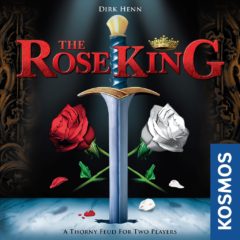
The Rose KingThe Rose King
Thames & Kosmos, 1997

Originally published as Texas by Ub-Spiele, Thames & Kosmo brings this great two-player game to the United States with a War of the Roses theme. The Rose King is an abstract area control game. It is simple to learn, but like most good two-player abstracts, harder to master.

The game consists of a square grid board, a small deck of direction cards, a bunch of two sided wooden discs, with white roses on one side, and red on the other, and 4 “Knight” cards per player. A Crown pawn starts in the middle of the board, and each player is given five direction cards, which are played out face up in front of them, with both players using the same orientation. (Most games the cards face “up” to each player. In The Rose King, the crown on the card will match the orientation of the crown on the board. So if the crown is closest to you on the board, then the crown on the card will be closest to you when played in front of you.) Each card has a sword pointing in a direction, and a number (I, II or III) indicating how many spaces the crown will move and in which direction.

Each player in turn will take one of three actions. 1: Play a card and move the crown, placing their color disc in the empty space that the crown now occupies. 2: Draw a new card. (You may never have more than 5 cards in hand) or 3: Play a card with one of your one-shot “knight” cards to move the crown to a space occupied by the other players piece, and flip it to your color.

That’s it. Three possible actions. Easy to learn and yet, so hard to master. Knowing which cards your opponent has to choose from, as well as knowing that they also know your cards gives a deceptive amount of depth to this simple game.

Scoring is based on the number of adjacent spaces you control, and you count all your pieces. A piece alone (not adjacent to any other of your color) counts one point. Two adjacent counts four. Three adjacent counts nine and so on. Breaking up your opponents “sets” or adding to your own is key to scoring high points.

I have shown this game to many people and every single one has been impressed with the depth of play that The Rose King offers, while being easy to learn. It is engaging, fun, and plays easily in a half-hour to 45 minutes.

Recommended.