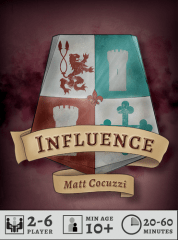
InfluenceInfluence
Two Monkey Studios/Game Salute 2014

If anyone was wondering if all I do are positive reviews, the answer is no. I’ve been debating on this one, but finally decided to give my two cents worth on this game. Influence is a 2-6 player short game. I tried twice to sit down with a group and the rules to puzzle out how to play this game. We gave up both times. The rules are confusing. Overall, it looks like it would be an easy game to play and learn, but as we figured out parts, we came across questions that either weren’t answered in the rules, or led to more questions that weren’t clear. After more than an hour with 3 people, 2 sets of rules, and the internet, we were still no closer to figuring out the game than when we started and finally gave up. I’m sure if someone who knows how to play were to put up a video, or were we to go to a convention or event where it was being demo’ed, we would probably enjoy the game, we just couldn’t figure out how it was supposed to play.

So here is where I go into my rant. Rules. Games are made or broken by them. Many a great game has had it’s downfall in poor rules, and many mediocre games have been made more fun and accessible by having great rules. They are such a critical part to every game. So, to game companies, put more time into your published rules than you do into your playtesting. Give your game to people and let them try to play it by learning the rules from your rulebook. As you see them get off track, don’t try to correct them, take notes and figure out how to write your rules better. Then playtest them with a new group who have never seen them. I’m serious. If people have trouble learning your game because of bad rules, you won’t get the sales, even if it is a great game. Make sure they are clear, concise, consistant and enjoyable to read. Add timing charts, or bulleted lists.

[getting off my soapbox] And so, in conclusion, this is a possibly good game, with rules bad enough that we walked away from it. Twice. You are welcome to give it a try, but until someone posts a video play, I wouldn’t recommend picking it up.
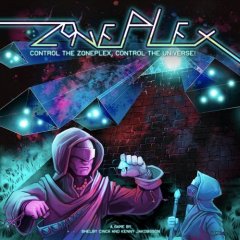
ZoneplexZoneplex
Mysterion Games/Game Salute, 2014

Zoneplex Is a space themed, middle weight game for 3-5 players. Each player is a warrior monk (you play with pieces they call Monkles instead of meeples) who is trying to take control of the Zoneplex pyramid. You overcome fears in order to become worthy to enter the eye of the pyramid. You are aided on your journey by various “relics of the bygone future eras”.  The idea behind this comes from an idea that ancient civilizations were really advanced starfaring races who created the Zoneplex.

Play is relatively simple to learn, but can be somewhat difficult to master, and depends a little more on luck than I would like to see.  You begin the game by drawing tiles to build the gameboard (placing triangular shaped tiles in a pyramid shape), place your 4 spirit stones in spirit chambers, and move around the board, attempting to gain relics.

You place your spirit stones on special spaces marked with different symbols. At the beginning of the game, each player is given a card with a secret symbol. At the midpoint of the game, when the last board tile has been played, the cards are revealed and influence points are scored.

On each turn of the game, you draw a card, which will tell you how many tiles to play, and how many spaces to move (1, 2 or 3), or will have a special power/event, or it may be a fear. Fears are monsters which you must defeat. You must defeat 3 fears (one of each type), have the most influence points, and reach the eye of the pyramid to win the game. Some of the board spaces are relic spaces which give you special relic cards which may give you influence, or other special game effects.

While we did enjoy the game, I did have a couple of difficulties with it. There are relic cards that give  extra influence, however there aren’t very many of them, and one player got the majority of them, giving that player a definite lead that was almost impossible to overcome. Also, you have to defeat fears of three different types, but if you never draw the correct fear, it can be impossible to win. You can ask others for help in defeating a fear, as many of them will require more than you can accomplish on your own. You can negotiate for help, including giving away the fear, or the relic “rewards” that come from defeating it. This is one way to get a fear that you need, if you can’t draw one, although the other players never have to make that deal. It would have been nice to see some cards, maybe in the relic deck, that allowed for the steal of a fear, or to look through the deck or discard for a specific fear.

Overall, we played a generous game, helping each other with fears for various benefits. We didn’t play very “hardcore”, and our game ended up pretty even at the end, with an exciting race for the finish. While this will never be one of my favorite games, it is probably worth a couple of plays to see if we can figure out some different strategies, or see how much luck of the draw really figures into the game.

TimelineTimeline
Asmodee, 2008

How well do you know your history? Think you’re pretty good? Then this series of lightweight fast paced games might just be for you. Timeline is a small game with a little over 100 cards in each set, each card has two sides. One side says the event/item/idea, the other has the year that that event/item/idea happened or was created. Each player has 4 cards in front of them, date side down. On their turn, the player picks one of their cards and adds it into the timeline on the table. Once placed, the card is flipped to see if they were correct in their placement. If correct, play continues to the next person. If they were incorrect, they have to draw a new card and try again on their next turn.  Easy, right?

There are currently 7 different timeline sets: Inventions, Discoveries, Historical Events, Diversity, Music & Cinema, American History and Americana. These sets are easily mixed and matched because each set is color coded. The Small (5” square) tin has a color on the top right corner of the lid, which matches the color on the dates on the cards. So you can easily mix sets to make a bigger pool of cards with different subjects, and just as easily sort them into their individual sets when you are done.

This deceptively easy concept can be fiendishly hard as you try to remember if Friends premiered before or after Tiger Woods became the youngest Masters champ. (It was before) It can also be very easy: Friends premiered after the first Stetson hat was sold. (Both examples from the Americana set.)

The artwork on the cards is nice, and can help you (or not) as you try to decide where in the current timeline to put your card.

A minus on this game is that eventually, you may learn the dates on the cards enough that the game becomes too easy. Wait… A MINUS that you learn historical dates? Yes, this game could be used for the nefarious purpose of TEACHING kids (and adults) about historical events and times. AND it’s fun as well. So go buy this as a stocking stuffer for those middle grade kids. It’s priced right and you will be giving them something worthwhile and fun. And while you’re at it, check with your kids’ teacher and see if one of these sets would be good for their classroom as well. Great teacher gift! Highly Recommended.

pic1701236_mdTop Promoter
Game Salute/Moore Games Please 2014

Top Promoter is a lightweight, quick, fun game. It is themed around boxing, but you don’t need to be a fan of boxing to enjoy this game. You are a promoter, attempting to get your fighters into arenas. Each arena has 3 bouts, with the main event paying out more than the earlier events. This mechanic works really well for giving you the thematic feel of the game. The game is for 3 to 5 players.

Each player has their own deck of fighters and promotional tricks. The card names are amusing and lighthearted (Larry lefty, Has Been, and the Big Chicken are just a few). Each fighter has a hometown, weight class, popularity rating and dice stat/knock out rating. The card art is fun, but is repeated (as are some of the names) in other decks. So you might have the same “person” come up against himself from a different promoter. That is just me being picky tho. I understand that in a game with 15 boxers times 5 players artwork can get pricy, but that little extra effort would really enhance the fun factor. It in now way effects the playability of the game. You only play once through your deck, so picking the right fighters gives a nice lightweight strategy to the game.

You begin the game by randomly selecting a number of locations based on the number of players. Lay out a number of face up locations equal to the number of players minus one. Each location supports 3 bouts, the bout closest to the location is the main event, the second is the Mid event, and the lower card is the starting event. Each player shuffles their deck and draws 6 cards. Each player selects one of their boxers and places it face down in front of them. When all have chosen, the cards are revealed and placed in the bout positions based on the highest popularity first. Boxers who are placed on the location that matches their hometown will get an extra dice when their match is played. Once placed, the players draw back up to 6 cards. Play continues until all bouts on a location fill. They immediately resolve first bout up to the main event. The players roll dice to determine the winner of the match and are paid out according to the bout position, length of the bout, and underdog bonus. Should a player win all three matches at a location, they will also receive a clean sweep bonus.

Once the last location is resolved, the game is over and the player with the highest amount of money wins the game.

This is a fun game with good balance and nice humor. Fun for all ages, regardless of your interest in boxing as a sport.  Recommended.